In this article
Autumn lunchbox food safety in Australia remains critical even as temperatures drop from summer highs. With autumn days still reaching 25-35°C across most Australian regions, the same food safety risks that threaten summer lunches persist well into March, April and May. Many parents relax their vigilance when summer "officially" ends, but Food Standards Australia New Zealand data shows 4.67 million Australians experience food poisoning annually — with inadequate food storage being a major contributor.
29%
of Australian school children had ice packs in warm-weather lunchboxes
NSW Food Authority 2009
598 children aged 4-12 surveyed
Autumn's variable temperatures create unique challenges. Morning packing happens in 15°C cool air, but by lunchtime, your child's food has spent 4+ hours in conditions that can exceed 30°C. This temperature fluctuation catches parents off-guard more than consistent summer heat.
Why autumn lunchbox food safety still matters in Australia
The statistics paint a clear picture of ongoing risk during Australia's autumn months. Beyond the 4.67 million annual food poisoning cases, research from the NSW Food Authority found only 29% of school children had adequate cooling in their lunchboxes during warm weather periods — and autumn's 25-35°C days definitely qualify as warm weather.
Autumn creates a false sense of security. Parents associate cooler mornings with reduced food safety needs, but Australian autumn temperatures vary dramatically:
- Sydney autumn: 20-28°C daily ranges
- Brisbane autumn: 22-30°C daily ranges
- Darwin autumn: 24-32°C daily ranges
- Perth autumn: 18-28°C daily ranges
The Australian Department of Health guidelines emphasise that perishable foods become unsafe after 4 hours at room temperature — and "room temperature" includes those 25°C autumn afternoons that feel mild compared to 40°C summer days.
Variable autumn weather compounds the challenge. Unlike summer's predictable heat, autumn brings warm days mixed with genuinely cool ones. Parents often pack identically regardless of daily forecasts, leading to either unnecessary ice pack bulk or dangerous food storage.
The 4-hour rule still applies
Perishable foods (dairy, meat, eggs, mayo-based items) become unsafe after 4 hours above 4°C. A 25°C autumn day poses the same risks as summer heat.
The temperature danger zone: when autumn weather fools parents
Autumn mornings that feel "cool" can still produce dangerous midday temperatures for lunchbox food safety. The critical threshold isn't about how the weather feels — it's about specific temperature ranges that allow bacterial growth.
The danger zone sits between 4°C and 60°C, with rapid bacterial multiplication occurring between 20-40°C. Most Australian autumn days hit this range by 10am, well before lunch period. Here's how regional autumn temperatures interact with food safety:
Sydney autumn patterns: March-May temperatures of 20-28°C mean ice packs remain essential through most of autumn. Only the coolest May days might allow safe storage without cooling.
Melbourne autumn patterns: The 15-25°C range offers more flexibility, but warm autumn days still require ice packs. Parents should check daily forecasts rather than assuming seasonal safety.
Brisbane and Darwin autumn patterns: These regions maintain summer-like food safety requirements through autumn, with temperatures consistently exceeding safe storage thresholds.
Timing amplifies the risk. Lunchboxes packed at 7am face 5-6 hours of storage before consumption. Even if morning temperatures start at 18°C, afternoon peaks of 26°C create perfect bacterial breeding conditions.
Autumn temperature danger periods by region
The morning-afternoon temperature swing creates the biggest trap. A 16°C start can reach 28°C by noon — that's a 12-degree increase that transforms safe storage into dangerous storage.
Decision tree: when to keep ice packs in autumn lunchboxes
Use ice packs whenever the forecast exceeds 22°C, regardless of season. This simple threshold eliminates guesswork about autumn food safety decisions.
Here's the decision framework:
Temperature-based decisions:
- Forecast 22°C+: Ice packs essential
- Forecast 18-21°C: Ice packs recommended for perishables
- Forecast under 18°C: Ice packs optional (but still safer)
Food-based decisions:
- Contains dairy, meat, or eggs: Ice packs non-negotiable
- Contains mayo-based salads: Ice packs non-negotiable
- All shelf-stable foods: Ice packs optional
Timing-based decisions:
- Lunch eaten after 1pm: Ice packs recommended regardless of temperature
- Lunch eaten before 12pm: More flexibility on cooler days
- Extended school days (after-school care): Ice packs essential
Daily ice pack decision process
Check weather forecast
Look up maximum temperature for your area
Assess food contents
Identify any perishable items requiring cooling
Consider timing
Factor in pack time to consumption time
Apply safety margin
When in doubt, include ice packs
Regional variations matter significantly. Darwin autumn requires summer-level precautions, while Hobart autumn offers genuine cooling opportunities. Don't assume Australia-wide autumn advice applies to your specific climate zone.
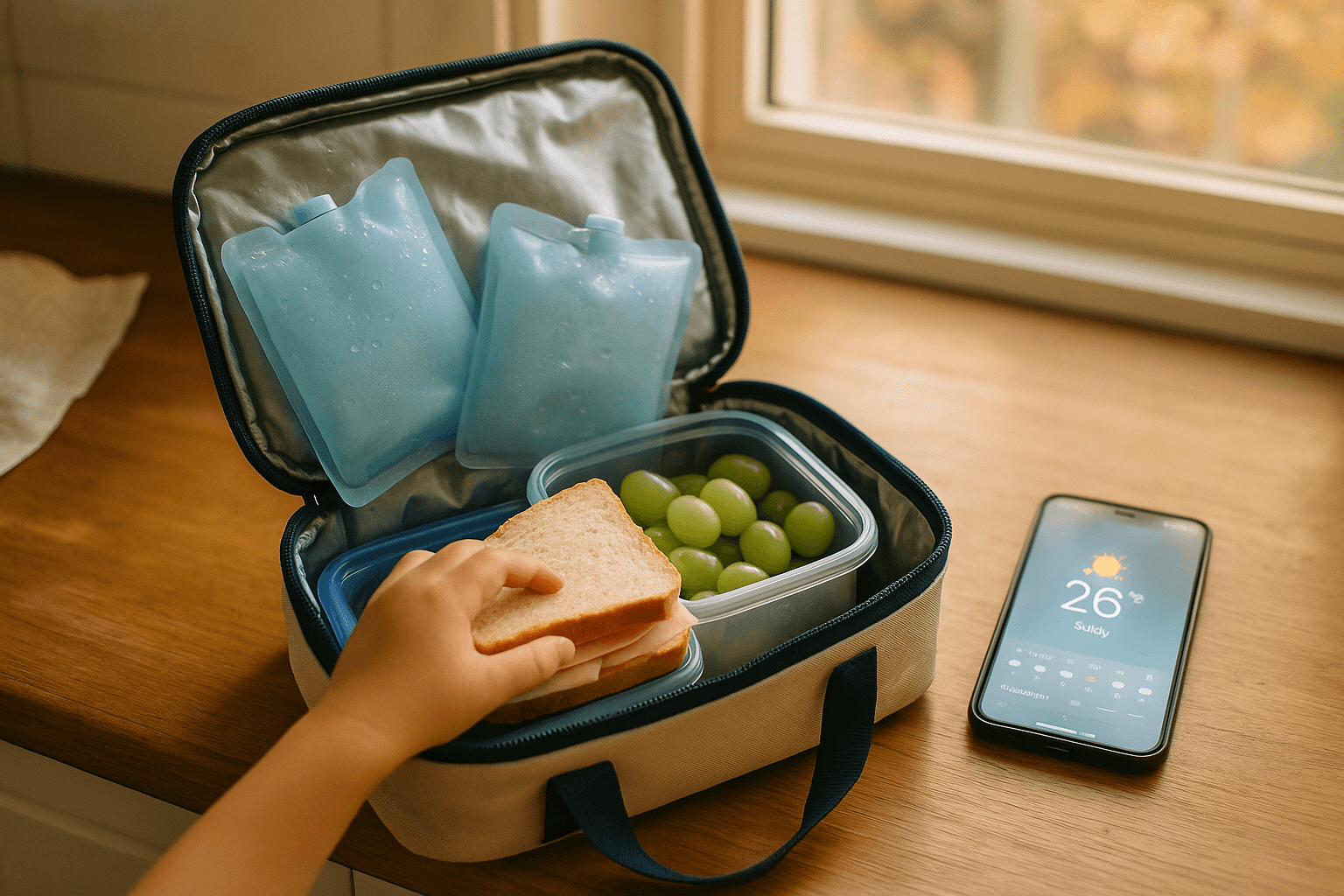
The Bentgo Reusable Ice Packs (4-pack) provide reliable cooling for variable autumn conditions. Having multiple packs means you can adjust cooling intensity based on daily forecasts rather than applying one-size-fits-all solutions.
Safe food choices for variable autumn temperatures
Shelf-stable proteins and oil-based preparations survive autumn temperature fluctuations better than dairy-based alternatives. When autumn weather predictions seem uncertain, building lunches around naturally stable ingredients reduces food safety anxiety.
Low-risk protein options:
- Canned tuna (unopened individual serves)
- Hard-boiled eggs (if consumed within 4 hours)
- Chickpeas and legumes
- Nuts and seeds
- Nut butters
Temperature-stable carbohydrates:
- Bread and wraps
- Rice cakes and crackers
- Pasta salads with oil-based dressing (avoid mayo)
- Plain cooked rice (cooled properly)
Resilient fruits and vegetables:
- Apples, oranges, bananas
- Grapes (wash and dry thoroughly)
- Cherry tomatoes
- Carrots, celery, cucumber
- Dried fruits
High-risk foods
- ·Yogurt
- ·Soft cheese
- ·Deli meat
- ·Mayo-based salads
Require ice packs in 20°C+ weather
Medium-risk foods
- ·Hard cheese
- ·Cooked pasta
- ·Boiled eggs
- ·Leftover pizza
Safe for 3-4 hours without cooling
Low-risk foods
- ·Fresh fruit
- ·Vegetables
- ·Crackers
- ·Nut butter sandwiches
Safe all day without cooling
Foods to avoid without ice packs on warm autumn days:
- Yogurt and soft cheeses
- Sliced deli meats
- Mayo-based potato or pasta salads
- Cream cheese spreads
- Leftover casseroles or stews
For warm autumn days without ice packs, the Thermos FUNtainer Food Jar 290ml offers an alternative strategy. Hot foods stay hot (and safe) for hours, eliminating temperature danger zone concerns entirely.
Building autumn lunchbox ideas around naturally stable ingredients means less stress about daily temperature forecasts and ice pack decisions.
Essential cooling strategies for unpredictable autumn days
Layer multiple cooling methods rather than relying on single ice pack solutions for variable autumn temperatures. This redundancy approach handles unexpected temperature spikes and equipment failures.
The layered cooling system:
- Insulated bag foundation: Insulated lunch bags provide the base thermal protection
- Primary ice pack: Dedicated cooling element positioned strategically
- Frozen drink bottle: Dual-purpose cooling and hydration
- Strategic food placement: Perishables closest to ice sources
Pre-chilling technique: Place the empty lunchbox in the fridge for 30 minutes before packing on warm autumn mornings. This thermal head start helps maintain lower temperatures longer.
Frozen drink bottles work double-duty as ice packs and refreshing drinks. As they thaw, kids get cold water while food stays cool.
Compartmentalised cooling: Products like the Yumbox Original and Sistema Bento Lunch Box allow strategic temperature management. Place ice packs adjacent to compartments containing perishables while keeping crackers and fruit in non-cooled sections.
Natural cooling agents: Frozen grapes, berries, or apple slices act as edible ice packs. They thaw into regular fruit by lunchtime while providing cooling during the danger period.
Testing ice pack effectiveness: Before relying on any cooling system, test it on a warm day. Pack the lunch normally, leave it in a car or warm room for 4 hours, then check if items feel adequately cool. Our ice pack effectiveness testing revealed significant performance variations between brands.
The PackIt Freezable Lunch Bag offers built-in cooling without separate ice packs — the entire bag freezes overnight and provides passive cooling all day. This eliminates the "did I remember ice packs?" morning panic.
When to upgrade to insulated bags: If you're using standard lunch bags with separate ice packs, autumn's variable temperatures might justify upgrading to purpose-built insulated systems for more consistent temperature control.
Daily lunchbox safety checklist for Australian autumn
Create morning and afternoon food safety routines that adapt to daily autumn temperature variations. Consistency in checking prevents the oversights that lead to unsafe food storage.
Morning preparation checklist:
- Check today's maximum temperature forecast
- Pre-chill lunchbox if temperature exceeds 22°C
- Include ice pack for any perishable foods
- Position perishables closest to ice source
- Add frozen drink bottle as backup cooling
- Set phone reminder to check afternoon temperature
Midday teaching points for children:
- Keep lunchbox closed until eating time
- Eat perishable items first if feeling warm
- Don't save dairy items for afternoon snacks
- Report if food smells or looks different
Afternoon food safety checks
Weekly maintenance routine:
- Deep clean lunchbox with antibacterial solution
- Inspect for cracks, wear, or odour retention
- Test ice pack freeze/thaw cycles
- Review weather patterns for upcoming week
- Adjust food choices based on temperature trends
Red flag responses: If food ever smells off, shows discoloration, or feels unexpectedly warm, discard immediately. Don't rely on taste-testing to determine safety — bacterial contamination isn't always detectable by flavour.
Document any food safety incidents (spoiled items, inadequate cooling) to improve future packing decisions. Patterns often emerge around specific weather conditions or equipment failures.
Get the Free Lunchbox Safety Guide
Temperature thresholds, food safety checklists & ice pack testing results.
Region-specific autumn food safety guidance
Australian autumn food safety requirements vary dramatically by region, with northern areas maintaining summer-level vigilance while southern regions offer genuine cooling opportunities. Understanding your specific climate zone prevents both over-cautious and under-cautious approaches.
Sydney autumn (March-May): Average 20-28°C Ice packs essential through April, optional in late May. The harbour city's mild autumn still produces regular 25°C+ days requiring full cooling protocols. Coastal areas may run cooler than western suburbs.
Melbourne autumn (March-May): Average 15-25°C
Most variable Australian capital for autumn food safety. Cool changes can drop temperatures dramatically, but warm autumn days still require ice packs. Check daily forecasts rather than assuming seasonal safety.
Brisbane autumn (March-May): Average 22-30°C Treat as extended summer for food safety purposes. Rare cooling opportunities mean maintaining ice pack protocols through most of autumn. Humidity compounds temperature risks.
Regional autumn ice pack requirements
| Feature | March | April | May |
|---|---|---|---|
| Sydney | Essential | Essential | Optional |
| Melbourne | Essential | Daily check | Cool days only |
| Brisbane | Essential | Essential | Essential |
| Darwin | Essential | Essential | Essential |
| Perth | Essential | Essential | Optional |
Darwin autumn (April-June): Average 24-32°C Highest food safety risk of any Australian capital during autumn. Maintain full summer protocols including mandatory ice packs, insulated bags, and careful food selection. "Dry season" doesn't mean "cool season."
Perth autumn (March-May): Average 18-28°C Mid-range risk with significant daily variations. Early autumn requires consistent ice pack use, while late autumn offers more flexibility. Mediterranean climate creates unpredictable temperature swings.
Adelaide autumn (March-May): Average 17-27°C Similar patterns to Perth with slightly more cooling opportunities. Continental climate means bigger temperature ranges — monitor daily forecasts for ice pack decisions.
Hobart autumn (March-May): Average 14-22°C Lowest food safety risk during autumn, with genuine cooling opportunities from April onwards. Still monitor warm autumn days, but ice packs become optional earlier than other capitals.
Adjust strategies as seasons shift within regions. Early autumn (March) requires more vigilance across all areas, while late autumn (May) offers regional variations in safety requirements.
What to do if you suspect lunchbox food went bad
Visual, smell and texture changes indicate food spoilage — never rely on taste-testing to determine safety. Teaching children to identify unsafe food prevents consumption of contaminated items.
Visual warning signs:
- Unusual discoloration or dark spots
- Mould growth (any amount)
- Excessive condensation inside packaging
- Separation of ingredients (mayo-based items)
- Slimy appearance on previously dry foods
Smell indicators:
- Sour or "off" odours
- Stronger than normal food smells
- Metallic or chemical scents
- Any smell that seems wrong for that food
Never taste-test suspect food
If food looks, smells or feels wrong, discard it immediately. Bacterial contamination can be present without obvious signs, and taste-testing risks food poisoning.
Texture changes:
- Unexpected mushiness or softness
- Slimy coating on normally dry foods
- Hard or dried-out foods that should be moist
- Unusual stickiness or film formation
Teaching children food safety recognition:
- "If it looks different, don't eat it"
- "Trust your nose — bad smells mean don't eat"
- "Tell a teacher if your food seems wrong"
- "It's always okay to throw food away if unsure"
Documentation for future prevention:
- Note temperature conditions when spoilage occurred
- Record which foods spoiled and which didn't
- Assess ice pack performance and placement
- Identify patterns around specific weather or equipment
When to contact schools: If lunchbox storage facilities seem inadequate (no refrigeration, excessive heat exposure, long delays before lunch), discuss concerns with teachers or administration. Schools should support parents' food safety efforts.
Document incidents to improve future packing strategies. Understanding what fails under which conditions helps refine your approach to autumn lunchbox food safety in Australia.
Autumn lunchbox safety FAQ
How useful was this?
Get Your Seasonal Safety Cheat Sheet
Temperature thresholds, ice pack rules & 20 safe autumn lunch ideas on one printable page.
Written by Pat
Dad of two, Melbourne. Half Chinese, raised on incredible food. I make quick school lunches and test every piece of gear before recommending it. No bento art — just real food made with love.