In this article
If you're shopping for back-to-school lunch boxes and drink bottles in Australia and want the best value, the short answer is: Kmart and Big W for under $20 a combo, Target and Smiggle for $20–$50, and specialist brands like Yumbox or Frank Green for $50+ if you're thinking long-term. What you're looking for, regardless of budget, is kid-openable latches, genuine insulation for Australian summer conditions, and compartments that match what you actually pack. According to Finder.com.au's 2026 back-to-school report, Australian families are projected to spend an average of $2,847 per primary school child on back-to-school costs this year — almost 1 in 3 parents say they can't afford it. The lunch box doesn't need to be where that money goes.
What actually makes a lunch box worth buying (and what's just marketing)
The features that genuinely matter in a kids' lunch box come down to 4 things: latch design, insulation, compartment layout, and material safety. Everything else — licensed characters, colour-matched accessories, brand names — is marketing.
Latch design is the one most parents underestimate. If your 5-year-old can't open the clip with their non-dominant hand, the teacher opens it every day, the kid gets frustrated, and the lunch comes home untouched. Test every latch before you buy. Flip the box over and try to open it one-handed. If you struggle, your kid has no chance.
Insulation is non-negotiable in Australia. Primary schools don't have refrigeration, and a 35°C schoolyard is not a benign environment for a cheese stick or a rice paper roll. A non-insulated plastic box reaches unsafe food temperatures within 2–3 hours on a hot day. More on this in the food safety section below.
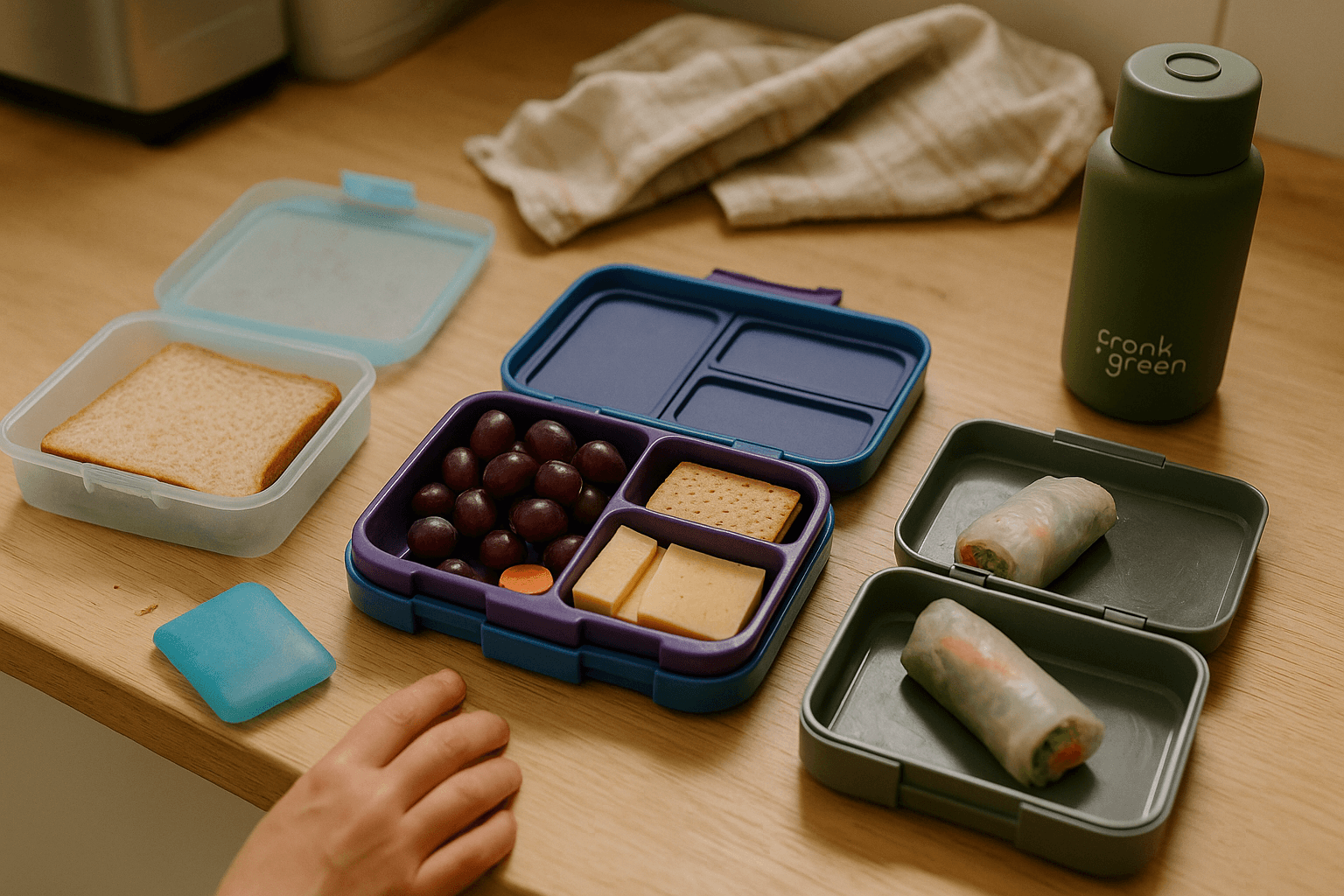
Compartment layout matters more than most buying guides admit. If you pack bento-style — dips, crackers, cut fruit, a rice paper roll — you need real dividers, not a single cavity with a removable tray that leaks into everything. Check out why compartments matter for lunch packing if you're moving away from sandwiches.
Material safety: every major Australian retailer — Kmart, Big W, Target, Coles, Woolworths — stocks BPA-free options as standard now. That's not a differentiator anymore. The real differentiator is lid seal quality. A loose lid seal means leaks in school bags, which means wet books and a very unhappy kid.
The one test worth doing in store
Before buying any lunch box, close the lid fully and turn it upside down over your hand. Shake it once. If liquid would escape, the seal isn't good enough for a school bag.
Where to shop in Australia: a retailer breakdown by budget
The best place to buy lunch boxes and drink bottles in Australia depends on what you're willing to spend — but knowing which retailer sits in which tier saves you a lot of comparison shopping.
Australian retailer tiers at a glance
| Feature | Kmart / Big W | Target / Smiggle | Specialist / Online |
|---|---|---|---|
| Price range (combo) | Under $20 | $20–$50 | $50+ |
| Insulation standard | Add ice brick | Most boxes insulated | Premium insulation |
| Compartments | Basic bento | Good bento options | Adult-format bento |
| Replacement parts | Some brands | ||
| Warranty | Limited | 1–5 years | |
| Kid-openable latches | Varies | Usually yes |
Supermarkets (Coles, Woolworths) restock budget-tier containers seasonally and are worth checking in January — quality is comparable to Kmart at similar price points. Online retailers like Amazon AU sometimes undercut physical stores on mid-range brands, but factor in delivery time if school starts in 2 weeks.
Budget tier: Kmart and Big W (under $20 for the combo)
The Sistema Bento Lunch Box (~$14.99 at Kmart) is the workhorse of the Australian school lunchbox scene. It's not glamorous, but the latches are solid, the compartments are genuinely useful, and it survives the kind of treatment a 7-year-old dishes out. Pair it with a Kmart own-brand water bottle and you're under $20 for the full combo.
For prep and Year 1 kids, the Munchkin Bento Toddler Lunch Box (~$19.99) is worth the slight premium. The latches are simpler — important when a 4-year-old is trying to get into their lunch without teacher intervention — and the compartment sizes are better scaled for smaller portions.
The honest limitation of the budget tier: no insulation. A Sistema box in a 35°C schoolyard is just a plastic box. Fix this by pairing it with Fit & Fresh Cool Coolers ice packs (4-pack, ~$12.99). The full setup — Sistema box plus ice pack — costs around $27.98 and keeps food safe through a full school day in summer.
Best for: families replacing a lost or broken box mid-year, or anyone trialling a new compartment layout before committing to a pricier option.
Budget tier (Kmart / Big W)
Pros
Lowest upfront cost — combo under $20
Wide availability, in-store year-round
Sistema and Munchkin are genuinely durable for the price
Easy to replace without budget stress
Cons
No insulation — requires separate ice brick for summer
No replacement parts or warranty support
Lid seals vary — test before buying
Brand fatigue for older kids (Year 5–6 notice)
Mid-range tier: Target, Smiggle and supermarket brands ($20–$50)
The mid-range is where most families land after their first budget box gets sat on, left at the park, or grows a mystery smell that won't wash out. The Bentgo Kids Lunch Box (~$44.99) is the pick of this tier. It has proper insulation built in, the latches are kid-openable from Year 1 up, and the 5-compartment layout handles everything from sandwiches to rice paper roll components without mixing.
The Yumbox Original (~$49.95) sits at the top of this tier and is worth it for families who pack bento-style. The seal design keeps compartments genuinely separate — dip doesn't bleed into crackers, fruit juice doesn't waterlog everything else. It's a meaningful upgrade from a standard divided tray.
For drink bottles, the CamelBak eddy+ Kids 400ml (~$29) adds insulation and a bite-valve spout at a mid-range price. The 400ml capacity suits prep through Year 2; older kids (Year 3–6) may want the 500ml variant.
Target's own-brand insulated lunch bags ($25–$35) pair well with any mid-range box and add a layer of thermal protection beyond what the box alone provides. Smiggle's strength is design appeal for primary-age kids — the gear holds up reasonably well, though you're paying partly for the aesthetic.
Best for: Year 3–6 kids who open their lunch independently, families who've already burned through one budget box and want something that lasts a full school year.
Premium tier: b.box, Yumbox, Frank Green and specialist stores ($50+)
Premium lunch gear justifies its price through 3 things: extended lifespan, replacement parts availability, and — for secondary students — peer credibility. These aren't trivial factors.
The Frank Green Ceramic Reusable Bottle (595ml, ~$54.95) is the clearest value case in this tier. It retains temperature for 12+ hours, the ceramic coating doesn't transfer taste, and Frank Green sells replacement lids and seals so the bottle doesn't become landfill when the original lid cracks. Used daily for 5 years, the cost per year is around $11 — cheaper than replacing a $15 bottle annually.
The Yumbox Tapas (~$54.95) is designed for secondary students and adults. Larger compartments, a slimmer profile, and a more grown-up aesthetic make it the right call for Year 7 and up. It also works well for adults who've graduated from packing kids' lunches to packing their own.
Specialist retailers — independent eco-focused stores, some Smiggle locations — stock premium brands and can answer questions about replacement parts and warranties that a Kmart checkout operator cannot.
Best for: families with multiple children (the cost amortises across 2–3 kids and 4–6 years), secondary students where peer opinion is a real factor, or anyone who's done the cost-per-year maths.
$7.33
per child per year for a $44 Bentgo box, used across 3 kids over 6 years
Calculated from retail price and estimated lifespan
Budget boxes replaced annually cost $10–$15/year with no resale value
Drink bottles: what to look for beyond BPA-free
Every bottle on the shelf in Australia is marketed as BPA-free. That's the floor, not the feature. The things that actually differentiate drink bottles are insulation, lid seal quality, opening size, and capacity.
Insulation matters more in the Australian climate than almost anywhere else. A single-wall plastic bottle loses temperature within 2 hours in summer heat — by recess, the water is warm; by lunch, it's genuinely hot. Double-wall stainless steel bottles (like the CamelBak eddy+ or Frank Green) maintain cold temperatures for 6–12 hours.
Lid seal quality determines whether the bottle leaks in a school bag. Test the lid by filling it, closing it fully, and inverting it over your hand. Any drip is a fail. Check out our lunchbox accessories guide for compatible straws, spouts and replacement seals worth stocking up on.
Opening size affects independence. Wide-mouth openings (40mm+) are easier for Year 1–3 kids to drink from and clean. Narrower spouts work better for older kids and secondary students who want to drink without removing a lid.
Capacity by age:
- Prep–Year 2: 400ml
- Year 3–6: 500ml
- Year 7+: 600ml+
Most kids drink more than parents expect when the bottle is easy to use. A bite-valve or flip-top spout removes the friction of unscrewing a lid, which means more fluid consumed across the day.
The cost-per-year argument for spending a bit more
Here's the maths most buying guides skip. A $12 Kmart water bottle replaced once a year costs $12/year. A $35 insulated stainless bottle lasting 4 years costs $8.75/year — and that's before you factor in resale value. Premium boxes like the Bentgo or Yumbox retain 30–50% of their value on Facebook Marketplace; budget boxes are essentially worthless secondhand.
For a worked example: a $44.99 Bentgo Kids Lunch Box used by 3 children over 6 years (one child per 2 years, handed down) costs $7.50 per child per year. A $14.99 Sistema box replaced annually for the same period costs $14.99 per child per year — and you're buying and throwing away 6 boxes instead of 1.
For a deeper look at how material choice affects long-term value, the material durability comparison breaks down stainless steel vs plastic across a 5-year horizon.
The caveat: this maths only works if the premium product actually lasts. Brands with replacement parts and warranties (Frank Green, Yumbox, Bentgo) have earned that reputation. Brands that look premium but don't support replacement parts are just expensive budget tier.
Cost per year by product tier (lunch box)
Buying by age: what works for prep vs Year 3 vs high school
The right lunch box at 5 is the wrong lunch box at 12. Buying by age — not just by price — is how you avoid mid-year replacements.
Prep–Year 2 (ages 4–7)
Priority: simple latches, smaller compartments, insulated bag essential. Kids at this stage are still developing fine motor skills. A clip that requires two-handed pressure or a precise squeeze is a barrier. The Munchkin Bento Toddler Lunch Box is designed for this — one clip, manageable compartments, sized for smaller appetites. Teachers at this stage will help, but you want to minimise how often they need to.
Pair any non-insulated box with an insulated lunch bag. The box keeps food organised; the bag keeps it safe.
Year 3–6 (ages 8–12)
Priority: bento compartments, kid-openable clips, 500ml bottle. By Year 3, most kids open their lunch independently. The Bentgo Kids or Yumbox Original works well here — multiple compartments handle the variety that keeps kids interested in eating what's packed. This is also the age where bento-style packing pays off: rice paper roll components, hummus and crackers, fruit and cheese all stay separate. See the full bento box buying guide for compartment-specific packing ideas.
Year 7+ (secondary)
Priority: sleek insulated bottles, adult-format containers, peer-appropriate aesthetic. The Frank Green bottle and Yumbox Tapas are both designed with this in mind. Secondary students are acutely aware of what their gear looks like. A cartoon-print lunch box from Year 4 will not survive Year 7 socially. Thermos food jars (the Thermos FUNtainer Food Jar 290ml, ~$34.95) work well for hot food — leftovers from dinner travel safely without refrigeration.
Multi-child families
A practical approach: budget tier for the youngest (high loss/breakage risk), mid-range from Year 3 (when kids are more careful), premium for secondary (where the gear lasts and matters). Hand down mid-range boxes from older to younger kids — a Bentgo that a 10-year-old has grown out of is still a perfectly good box for a 7-year-old.
When to buy: the back-to-school sale window explained
The single best time to buy lunch boxes and drink bottles in Australia is early January — not late January, not December, and definitely not February at full price.
Here's how each retailer plays it:
- Kmart runs everyday low pricing year-round, but January stock clearance produces 10–20% bundle discounts on selected back-to-school ranges. Stock is fullest in the first 2 weeks of January.
- Big W uses Everyday Rewards multipliers (3x–5x points) during January sale weeks, which stack with any price reductions. If you hold a Woolworths Everyday Rewards card, this is meaningful.
- Target clears previous season stock in early January and brings new ranges in at full price from mid-January. Buy in the first 2 weeks to access clearance pricing.
- Smiggle and specialist retailers rarely discount deeply but often run bundle deals (box + bottle + bag) that represent reasonable value if you're buying all 3.
The timing risk: popular sizes and colours sell out by late January. If you're buying for prep, the smaller compartment sizes go first. Buy in early January when stock is full and discounts peak.
Don't leave it to the last week of January
By the last week of January, Kmart and Big W are routinely out of stock on popular sizes. Late buyers end up paying full price at Target or Smiggle for whatever's left. The sale window is real, and it closes.
The food safety case for insulation in Australian conditions
Insulation is the feature most buying guides treat as optional. In Australia, it isn't.
According to Food Standards Australia New Zealand (FSANZ), perishable foods should not be held between 5°C and 60°C for more than 4 hours — the range in which bacterial growth accelerates. A non-insulated lunch box in a 35°C schoolyard can breach the 15°C threshold within 2 hours. That means a cheese sandwich packed at 7:30am may be technically unsafe by first recess.
Approximately 90% of Australian primary school-aged children bring meals from home each day, according to research published in Public Health Nutrition — and primary schools do not have refrigeration. The food safety burden sits entirely with the lunch box.
The practical fix:
- Insulated lunch bag + ice brick for any lunch containing dairy, meat, egg, or prepared foods (rice paper rolls, dips, anything with mayonnaise). The PackIt Freezable Lunch Bag (~$39.95) is the most effective option I've tested — the entire bag freezes, not just a removable insert. The Bentgo Reusable Ice Packs (4-pack, ~$16.99) work well with any existing bag.
- Shelf-stable items (whole fruit, crackers, dry nuts, sealed muesli bars) don't require insulation and can safely fill the non-perishable compartment.
- Thermos food jars eliminate the cold chain problem for hot food entirely. The Thermos FUNtainer 290ml (~$34.95) keeps food above 60°C for 4+ hours if pre-heated with boiling water for 2 minutes before filling.
For a detailed breakdown of what insulated bags actually achieve in Australian summer conditions, the insulated lunch bag guide covers testing methodology and temperature results across 6 bag types.
In an Australian schoolyard, insulation isn't a premium feature — it's food safety infrastructure. A $27 Sistema box plus $13 ice pack combo keeps food safer than a $50 uninsulated designer box with no cooling solution.
Quick buying checklist: questions to ask before you buy
Before you buy: run through these
For cooling solutions specifically, our ice pack effectiveness testing covers 6 different ice pack types across a full school day in summer conditions — useful if you're not sure whether a standard supermarket ice brick is doing the job.
Free: 20 lunchbox ideas on one page
Print it, fridge it — quick reference for the whole school year, no scrolling required.
Final word: invest in the right container, not the brand
The best value lunch box and drink bottle setup in Australia isn't always the cheapest, and it's rarely the most expensive. It's the one matched to your child's age, your climate, and what you actually pack.
- Budget-conscious families: Sistema Bento + Fit & Fresh ice pack combo (~$27.98) is a genuinely solid setup. Add an insulated bag if you're in a hot climate or packing dairy.
- Mid-range sweet spot: Bentgo Kids Lunch Box + CamelBak eddy+ bottle (~$74 combined) lasts 3+ years and beats the budget tier on cost-per-year from year 2 onwards.
- Premium justification: Frank Green or Yumbox Tapas makes sense for secondary students, multi-child families handing gear down, or anyone who's calculated the 5-year cost and come out ahead.
Shop early January, tier your purchase by child age, and run the cost-per-year calculation before you default to the cheapest option on the shelf.
Frequently asked questions
Sources
- [1]Back to school costs and statistics for 2025/2026 — Finder.com.au, April 2026
- [2]Food safety: keeping food safe at home — Food Standards Australia New Zealand (FSANZ), 2024
- [3]Parents face several barriers in providing a healthy school lunch for their primary school children: A survey of Victorian (Australian) parents — Health Promotion Journal of Australia, 2024
- [4]Interest-holders' views of implementing a school lunch program in primary schools within Australia — ScienceDirect / Zarnowiecki et al., 2018
How useful was this?
20 lunchbox ideas — one page, print and done
Got the box sorted? Now fill it. Free cheat sheet with 20 ideas that actually fit a bento layout.
Written by Pat
Dad of two, Melbourne. Half Chinese, raised on incredible food. I make quick school lunches and test every piece of gear before recommending it. No bento art — just real food made with love.