In this article
The best lunch box for an Australian kid isn't the one with the most Instagram traction — it's the one that keeps food safe in 35°C heat, survives the dishwasher for two years, and can actually be opened by a 5-year-old without a meltdown. Picking the wrong one costs you more in replacements and wasted food than the price difference ever justifies. I've tested a lot of these with my own kids, and the research below cuts straight to what matters.
According to a Flexischools survey of 1,000 Australian parents, the average family spends 2.6 hours per week on school lunch preparation — more than 100 hours annually. A lunch box that doesn't accommodate leftovers, leaks yoghurt into the bag, or fails at the seal after one school year makes every one of those hours harder.
What to look for in a kids' lunch box (before you spend a cent)
The right lunch box starts with four functional requirements, not aesthetics. Get these right and most purchasing decisions become straightforward.
Leakproof seals are the single most important feature — and the most common failure point. Seal degradation is the number one reason a lunch box gets replaced before the structure shows any wear. Silicone seals on plastic boxes typically hold up for 18–24 months of regular dishwasher use before they lose their compression. After that, you're packing yoghurt at your own risk.
Insulation and ice brick compatibility matter more in Australia than most product reviews acknowledge. The NSW Food Authority's lunchbox research found that boxes without a cooling device contained up to 3 times higher bacteria levels than insulated boxes with an ice brick. In a Sydney or Brisbane summer, an uninsulated box sitting in a bag from 8am hits the danger zone well before noon.
Compartmentalisation has shifted from a nice-to-have to a compliance requirement at many Australian schools. Nude food policies — which ban individually wrapped snacks and require packaging-free lunches — are now in place at a growing number of primary schools. A bento-style box with built-in sections isn't a lifestyle choice for these families; it's the only option that meets school rules.
Weight is genuinely relevant for younger kids. A stainless steel lunch box typically adds 400–500g to a school bag compared to a lightweight plastic alternative. For a 4 or 5-year-old carrying their own bag, that's not trivial.
Independence factor — whether a child can open the box unassisted — is one of the most-searched questions parents have, and almost no review addresses it honestly. Multi-clip systems with stiff silicone seals are reliably beyond most 4-year-olds. Single-clip or tab-lift designs are manageable by kindy age.
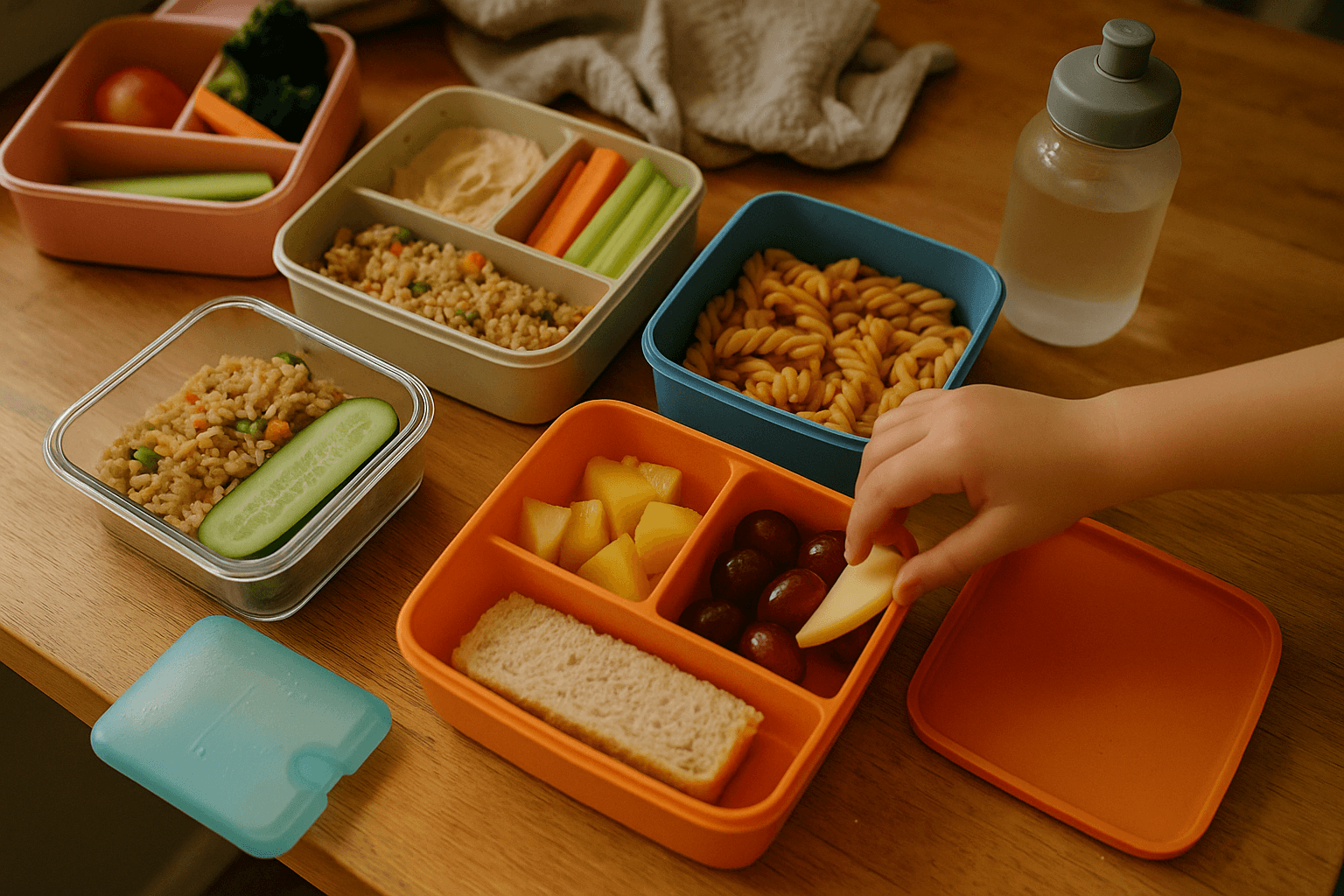
Leftover compatibility is the angle most reviews miss entirely. If you cook dinner with tomorrow's lunch in mind — fried rice, pasta, a curry, rice paper roll components — the box needs compartment depth of at least 5–7cm and enough internal volume to hold a real portion. Shallow bento trays designed for crackers and grapes won't cut it.
Bento, insulated or nude food: which type suits your family?
Three main lunch box formats dominate the Australian market, and each suits a different household situation.
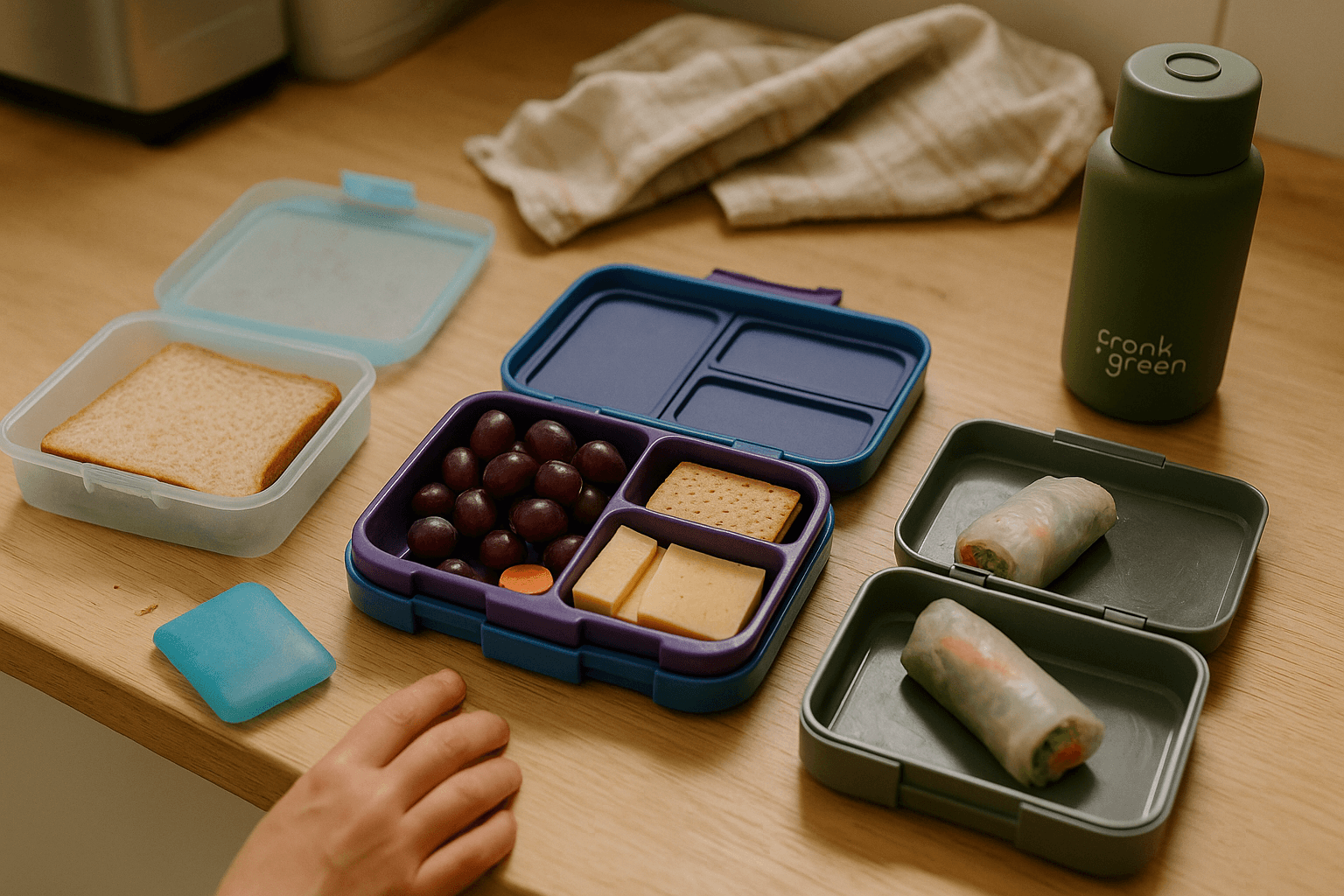
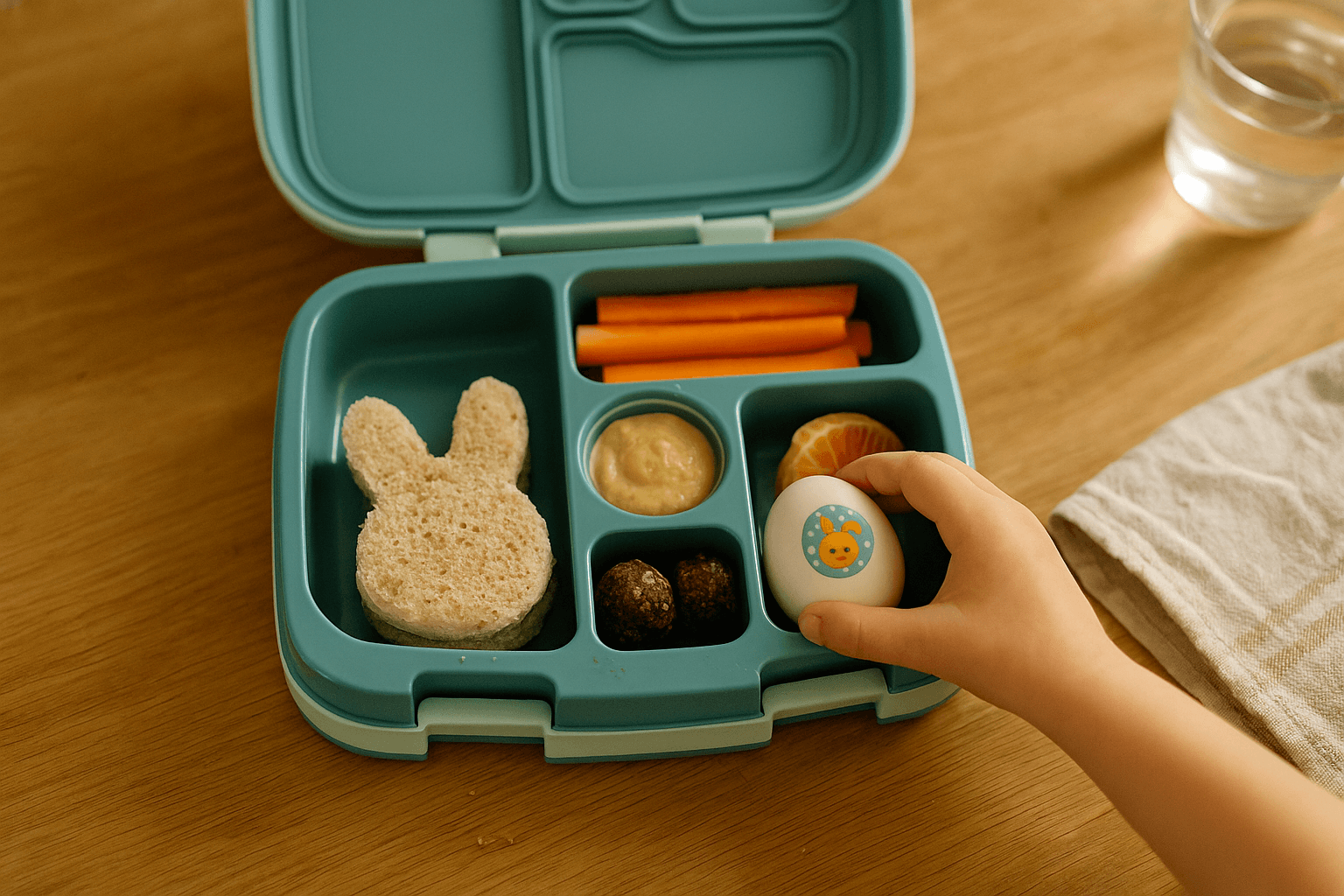
Bento boxes use a compartmentalised tray design — usually 3–5 separate sections — that keeps foods from touching and eliminates the need for individual wrapping. They're the standard choice for nude food policy compliance and work well for variety-heavy packs: fruit, cheese, crackers, a protein, a dip. Most bento boxes are not insulated, so they need an ice brick in warm weather.
Insulated lunch boxes use a foam or vacuum-insulated outer shell to slow heat transfer. They're not always compartmentalised internally, but some — like the OmieBox — combine insulation with a built-in thermos compartment. These are the right call for families packing dairy, meat or reheated leftovers in Australian summer conditions.
Nude food boxes are essentially bento boxes marketed explicitly for packaging-free compliance. The Nude Food Movers range is the most prominent Australian example — designed from the ground up to eliminate the need for cling wrap, zip-lock bags or foil. If your school enforces nude food policies, this category is worth understanding. See our nude food policy compliance guide for the full breakdown.
Thermos-compatible boxes — where one compartment accepts a standard thermos insert — suit families doing dinner-to-lunchbox prep. Hot food stays warm for 4+ hours when the thermos is pre-heated with boiling water before filling.
For most dual-income households with kids aged 5–10, a bento-style box with a leakproof seal and ice brick compatibility covers 90% of use cases. The exceptions are families with younger kids who need simple clips, or families regularly packing hot leftovers.
Nude food policy check
Before buying, check your school's specific policy. Some schools require fully packaging-free lunches (no zip-lock bags, no foil, no wrappers). A bento box with compartments satisfies most policies — but confirm before you spend $50 on a box that doesn't meet the brief.
The best lunch boxes for Australian kids, by category
Every recommendation below has been selected on four criteria: leakproof performance with wet foods, seal durability over 12+ months of dishwasher use, age-appropriate clip design, and real-world compatibility with the kind of lunches Australian families actually pack.
Best budget pick: Sistema Bento Lunch Box (~$15)
The Sistema Bento Lunch Box is the most practical entry-level option available at Kmart, Big W and most supermarkets. At around $15, it's the box I'd recommend to anyone who wants to try a bento-style format without committing to a premium price.
At 200 school uses over 18 months, that works out to roughly 3 cents per use — genuinely good value, provided you replace it when the seals start to go. The compartmentalised design meets nude food policies. The clips are manageable for kids aged 6 and up; younger kids may need help with the four-clip system.
The limitation is insulation: Sistema boxes are not insulated, so an ice brick is non-negotiable in Australian summer. They're also not thermos-compatible, which rules them out for hot leftover packs.
Sistema Bento Lunch Box
Pros
Under $15 at Kmart and Big W
Compartmentalised — nude food compliant
Leakproof seals hold well for 12–18 months
Lightweight plastic suits younger primary kids
Cons
Not insulated — requires ice brick in summer
Seal degradation typical after 18 months
Four-clip system can frustrate 4–5 year-olds
Not thermos-compatible for hot leftovers
Best mid-range pick: b.box Lunch Box (~$35–40)
The b.box Lunch Box is the most consistently recommended mid-range option among Australian parents, and for good reason. It's BPA-free, lightweight, and the leakproof seals have a track record of lasting beyond 2 years with regular use — longer than most plastic competitors at this price.
The clip design is easier than Sistema's for younger kids, making it a realistic option from age 5 upward. It fits standard ice bricks and is compatible with thermos inserts, which gives it more flexibility for leftover-based packs. At $35–40, the cost-per-use over 2+ years works out to around 5–6 cents — slightly more than Sistema per use, but the extended lifespan and better seal durability close the gap quickly.
For nude food compliance, it ticks the box. For families wanting durability without the weight of stainless steel, this is the practical choice.
Best for hot food: OmieBox (~$60–70)
The OmieBox is built around a single insight: some kids won't eat cold leftovers, and reheating at school isn't an option. The integrated thermos compartment keeps food warm for 4+ hours — enough to get fried rice, pasta or a curry to lunchtime in edible condition.
This is the lunch box I reach for when I've made a big batch of something the night before and want it in the box the next morning without any fuss. Pre-heat the thermos compartment with boiling water for 5 minutes, fill, seal, done. For more on that approach, our thermos lunch leftover ideas covers 25 dinner-to-lunchbox builds that work well in the OmieBox format.
The trade-off is weight — around 600g empty — and price. It's not ideal for kids under 7 carrying their own bags. But for upper primary kids eating real portions of real food, it's the most practical hot-lunch solution on the market.
Best stainless steel option: EcoCocoon or Nudie Rudie (~$45–65)
Stainless steel lunch boxes from EcoCocoon and Nudie Rudie offer the longest lifespan of any option here — 4+ years is realistic, and seal degradation is less of an issue because the steel interior doesn't warp or absorb odours. For a stainless steel vs plastic durability comparison, the maths over four years favours stainless if budget allows upfront.
The honest caveat: these boxes are 400–500g heavier than plastic alternatives. That's a meaningful addition to a young child's bag. I wouldn't put one in a kindy bag. For a Year 4 or 5 student with a proper school bag, it's fine.
Neither option is natively compartmentalised in a way that eliminates all wrapping, so nude food compliance may require separate silicone containers inside the box.
Best for nude food schools: Nude Food Movers (~$30–40)
The Nude Food Movers range was designed specifically for Australian schools enforcing packaging-free policies. The compartmentalised layout eliminates the need for individual wrapping across all food items, and the leakproof seals prevent cross-contamination between wet and dry sections.
At $30–40, it sits between Sistema and b.box on price, with a cost-per-use of around 4–5 cents over 2+ years. The clips are manageable for kids aged 5 and up. If nude food compliance is the primary driver, this is the most purpose-built option available.
Best lunch boxes for Australian kids — quick comparison
Sistema Bento
~$15
- ·Compartmentalised
- ·Nude food compliant
- ·Dishwasher safe
Cheapest option
Widely available
Lightweight
Not insulated
Seals degrade at 18 months
4-clip system tricky for young kids
Best entry-level pick for budget-conscious families with kids 6+
b.box Lunch Box
~$35–40
- ·Leakproof
- ·Nude food compliant
- ·Ice brick compatible
Durable seals 2+ years
Easy clips for 5+
Thermos insert compatible
Not insulated
Mid-range price
Best all-round mid-range pick for most Australian families
OmieBox
~$60–70
- ·Integrated thermos
- ·Insulated
- ·Hot food 4+ hours
Perfect for leftover meals
Reduces ice brick reliance
Durable seals 3+ years
Heavier (~600g)
Higher price
Not ideal for under-7s
Best pick for families doing dinner-to-lunchbox meal prep
EcoCocoon / Nudie Rudie
~$45–65
- ·Stainless steel
- ·Insulated
- ·4+ year lifespan
Exceptional durability
No odour absorption
Best long-term value
Heaviest option
Not compartmentalised
Not ideal under age 8
Best for upper primary kids; families prioritising longevity
Nude Food Movers
~$30–40
- ·Packaging-free design
- ·Compartmentalised
- ·Leakproof seals
Purpose-built for nude food policies
Easy clips for 5+
Good value
Not insulated
Less widely stocked
Best for families at schools enforcing nude food policies
Food safety in Australian heat: why insulation actually matters
Food safety is the most under-discussed criterion in Australian lunch box reviews, and the data behind it is more specific than most parents realise.
NSW Food Authority research found that lunchboxes stored at ambient temperature contained up to 3 times higher bacteria levels than those packed with a cooling device. More specifically: cut watermelon without an ice brick showed bacteria levels 13 times higher by 2pm. In Australian summer ambient temperatures of 25–35°C, perishable food enters the bacterial danger zone (above 5°C) within 2–3 hours of leaving the fridge.
That's not a hypothetical. It means a lunch packed at 7:30am and eaten at 1pm — a realistic school day timeline — has been sitting in the danger zone for several hours if there's no ice brick and no insulation.
3x
More bacteria in uninsulated lunchboxes
NSW Food Authority, 2023
Compared to insulated boxes with an ice brick, in Australian ambient conditions
The practical response is straightforward: any lunch box carrying dairy, meat, cut fruit or dips needs either insulation or an ice brick — ideally both. Our ice pack effectiveness testing covers which ice packs actually hold temperature across a school day, which is worth reading before you buy.
For families packing hot leftovers, the OmieBox thermos compartment keeps food above 60°C (out of the danger zone from the hot side) for 4+ hours when pre-heated correctly — a different but equally valid food safety approach.
The 4-hour food safety rule is the relevant standard here: food held between 5°C and 60°C for more than 4 hours should be discarded. Most school lunches are packed 5–6 hours before they're eaten. Without cooling, you're past the safe window before the bell rings.
Which lunch box suits which age group?
Age-specific lunch box selection comes down to 3 variables: clip complexity, portion volume, and carry weight.
Ages 4–5 (kindy and early Prep): Lightweight plastic is essential — these kids are carrying their own bags, and an extra 400g matters. Clip systems should be simple: a single tab-lift or a 2-clip design. The Sistema and Munchkin Bento Toddler Lunch Box both fit this profile. Avoid multi-clip systems with stiff seals; a child who can't open their box at lunch is going to have a bad day.
Ages 6–8 (lower primary): Kids at this stage can manage moderate clip complexity and benefit from proper compartmentalisation for variety. The b.box and Bentgo Kids both work well here. Portion volume becomes relevant — a 6-year-old needs meaningfully more food than a 4-year-old, and shallow bento trays fill up fast.
Ages 9–12 (upper primary): Larger capacity matters. These kids can manage thermos lids, complex seals and heavier boxes without frustration. The OmieBox, Yumbox Tapas and stainless steel options all become viable. Weight is less of a concern once kids are using a structured school bag with shoulder straps.
Recommended lunch box weight by age group (empty box, grams)
Portion size also scales significantly: a 4-year-old needs roughly 1,000–1,200 kcal across the day, while a 10-year-old needs 1,800–2,000 kcal. The lunch box needs enough volume to hold a real portion — not just a snack tray.
Cost-per-use breakdown: what you actually spend over one school year
Most parents evaluate lunch boxes on sticker price. The more useful number is cost-per-use — what you actually spend per school day over the realistic lifespan of the box.
A school year in Australia runs approximately 200 days. Here's how the main options stack up:
Cost-per-use: lunch boxes over their realistic lifespan
3¢
Sistema Bento
$15 over 18 months (300 uses)
5–6¢
b.box
$38 over 2+ years (600+ uses)
3–4¢
OmieBox
$65 over 3+ years (600+ uses)
2–3¢
EcoCocoon
$60 over 4+ years (800+ uses)
Source: Prices based on current Australian retail, Feb 2025
The counterintuitive finding: cheap alternatives under $10 — the kind you find in discount bins — typically last one term before seals fail or clips break. At 40 uses over one term, a $10 box costs 25 cents per use. That's 8 times worse value than a Sistema, and 10 times worse than stainless steel.
Replacement seals are worth factoring in for plastic boxes. Premium options like the Yumbox have replacement seals available for around $10–15 at the 2-year mark, which extends the lifespan without replacing the whole box. Budget plastic options are typically non-repairable — when the seal goes, the box goes.
For a full breakdown with worked examples, our cost-per-lunchbox analysis covers the numbers across eight boxes over a four-year primary school window.
Leakproof performance: which boxes actually hold yoghurt and dips?
Leakproof claims are common. Actual leakproof performance varies considerably, and the difference matters when you're packing hummus or yoghurt next to a sandwich.
The mechanism behind a good leakproof seal is compression — the clip pulls the lid down hard enough that the silicone gasket deforms slightly and fills any gap. Clip-based systems outperform snap-fit lids because they maintain consistent compression. Snap-fit lids can lose tension after repeated dishwasher cycles.
Dishwasher use is the main accelerant of seal failure. The combination of heat and detergent degrades silicone over 18–24 months of regular top-rack washing. Hand-washing the seal (while machine-washing the box itself) extends seal life by 6–12 months — a small habit with a meaningful impact on longevity.
In practical testing with yoghurt and dips in a tilted box held for 4 hours — roughly simulating a school bag in transit — the Sistema Bento, b.box and Bentgo all hold without leaking when seals are in good condition. Budget alternatives under $10 frequently fail this test within the first few months.
A quick seal health check: run a wet finger along the seal surface. If water beads and rolls off, the silicone is still performing. If it absorbs or sits flat, the seal needs replacing.
Dishwasher and seal life
Putting the entire box — including the seal — on the top rack every day is the fastest way to shorten its leakproof lifespan. Remove the silicone seal and hand-wash it separately. Two minutes of extra effort adds months to the box's useful life.
Dinner-to-lunchbox meal prep: which boxes fit leftovers?
If you cook dinner with tomorrow's lunch in mind — and if you're a time-poor household, this is one of the most effective ways to cut weekly prep time — the lunch box you choose needs to accommodate real food, not just snack components.
Rice, pasta, fried rice, curry, noodles and rice paper roll components all need compartment depth of at least 5–7cm. Shallow bento trays designed around crackers and grapes overflow immediately with anything saucy or chunky. This is a real design limitation that almost no review mentions.
The Yumbox Tapas and OmieBox are the two boxes I'd recommend specifically for leftover-based packing. The OmieBox thermos compartment handles reheated food; the Yumbox Tapas has deeper compartments than the standard Yumbox Original, making it better suited to rice-based builds.
For the actual leftover ideas — what to cook and how to pack it — our leftover dinner to lunchbox ideas covers 15 dinner builds that translate directly into next-day lunches without any extra cooking.
20 lunchbox ideas on one page
Print the free cheat sheet, stick it on the fridge, stop staring at an empty bench at 7am.
One practical note on hot food safety: if you're packing reheated leftovers in a thermos compartment, the food needs to be piping hot (above 60°C) when it goes in, and the thermos needs to be pre-heated with boiling water for at least 5 minutes beforehand. This keeps the food above the danger zone until lunchtime. Don't pack warm leftovers — pack hot ones.
Frequently asked questions
Sources
- [1]Lunchbox Safety — Food Safety at Home — NSW Food Authority, 2023
- [2]Australian parents to spend 100+ hours on school lunches in 2025 — Flexischools, February 2025
- [3]Parents face several barriers in providing a healthy school lunch for their primary school children — Health Promotion Journal of Australia, 2024
How useful was this?
20 lunch ideas on one page — free
You've picked the right box. Now fill it without thinking. Print the cheat sheet and stick it on the fridge.
Written by Pat
Dad of two, Melbourne. Half Chinese, raised on incredible food. I make quick school lunches and test every piece of gear before recommending it. No bento art — just real food made with love.